
 The Société Jersiaise online bookshop has updated its stock listings, and the Jèrriais dictionaries can be ordered online. Buy now while stocks last!
Tuesday, 31 August 2010
Dictionnaithes - Dictionaries
The Société Jersiaise online bookshop has updated its stock listings, and the Jèrriais dictionaries can be ordered online. Buy now while stocks last!
A short tale about a short tail
A cédile is a cedilla - the little hook or tail under a letter c that tells us to pronounce it as /s/. It also tells us something else: that the name or word has been imported from French. The French language uses quite a lot of cedillas to denote a c pronounced as /s/ in front of vowels a, o, and u (a c followed by other vowels is pronounced /s/ anyway). However, Jèrriais generally doesn't need a cedilla because sound changes have in many cases turned a /k/ into a /sh/ which we write ch.
Compare:
Verb conjugations
French verb conjugations sometimes require a verb stem ending in c to take a cedilla in positions where Jèrriais grammar doesn't require it:
However, sometimes the cedilla is grammatically unavoidable, especially when dealing with borrowed vocabulary:
What happens in the future, though, when we want to conjugate one of the few verbs with a stem ending in c? If you favour the form annonchi, for example, then writing j'annonch'chais with a long ch presents no problem. What, though, if you favour the form annoncer? Presumably you could say j'annoncéthai, for example, but don't most people use a long /s/? But how to write it? Lé Jèrriais pour tous gives no specific guidance, but following the rules logically, one would expect to see ç'ç - but would anyone write that, though? We have a future form annonc'sa attested in text of the highest literary register possible. It is simple, but not transparent. What are the alternatives? Comments welcome.
Verb s'gencer/s'genser exists in both spellings, so following that pattern might be one solution.
Fixed forms
Some words and names with cedillas are simply borrowed like that: Français has been borrowed from French like that (although we could just as well spell it Franceis like Wace did), and the Dictionnaire specifically cites the name Françouais under the entry for cédile. The French form Français has, presumably, been preserved under the influence of French as an official language. We've borrowed Provence and Provençal (although Provenche and Provenchais are Jèrrified alternatives).
Borrowings and their alternatives
Some words with cedillas we've borrowed, but we still have native alternatives available.
There are a couple of borrowed words with cedillas that have almost completely displaced native Jèrriais words.
Odd ones out
Some prominent French words with cedillas have no related equivalents in Jèrriais (they may be recent developments for which Jèrriais has developed its own vocabulary, separate from any common ancestor).
halître (J.) - gerçure (Fr.)
craûle, chôl'ye (J.) - balançoire (Fr.)
côtchiéthe (J.) - façade (Fr.)
drâses (J.) - caleçon (Fr.)
ain (J.) - hameçon (Fr.)

Compare:
- chenna (Jèrriais) - ça (French)
- machon (J.) - maçon (Fr.)
- gliaichon (J.) - glaçon (Fr.)
- m'nichant (J.) - menaçant (Fr.)
- r'chu (J.) - reçu (Fr.)
- faichon (J.) - façon (Fr.) - and it is fashion that English has borrowed
Verb conjugations
French verb conjugations sometimes require a verb stem ending in c to take a cedilla in positions where Jèrriais grammar doesn't require it:
- grînchit (J.) - grinça (Fr.)
- annoncit (J.) - annonça (Fr.) (although the Jèrrified verb form annonchit is also available - and a similar situation exists with prononcer/prononchi, giving us prononçabl'ye/prononchabl'ye - prononçable)
- înfluencit (J.) - influença (Fr.)
However, sometimes the cedilla is grammatically unavoidable, especially when dealing with borrowed vocabulary:
- j'înfluençons (J.) - nous influençons (Fr.)
What happens in the future, though, when we want to conjugate one of the few verbs with a stem ending in c? If you favour the form annonchi, for example, then writing j'annonch'chais with a long ch presents no problem. What, though, if you favour the form annoncer? Presumably you could say j'annoncéthai, for example, but don't most people use a long /s/? But how to write it? Lé Jèrriais pour tous gives no specific guidance, but following the rules logically, one would expect to see ç'ç - but would anyone write that, though? We have a future form annonc'sa attested in text of the highest literary register possible. It is simple, but not transparent. What are the alternatives? Comments welcome.
Verb s'gencer/s'genser exists in both spellings, so following that pattern might be one solution.
Fixed forms
Some words and names with cedillas are simply borrowed like that: Français has been borrowed from French like that (although we could just as well spell it Franceis like Wace did), and the Dictionnaire specifically cites the name Françouais under the entry for cédile. The French form Français has, presumably, been preserved under the influence of French as an official language. We've borrowed Provence and Provençal (although Provenche and Provenchais are Jèrrified alternatives).
Borrowings and their alternatives
Some words with cedillas we've borrowed, but we still have native alternatives available.
- soupçon, doutanche (J.) - soupçon (Fr.)
- soupçonner, r'douter (J.) - soupçonner (Fr.)
- rançonner, racater (J.) - rançonner (Fr.)
- commèrçant, marchand, boutitchi (J.) - commerçant (Fr.)
There are a couple of borrowed words with cedillas that have almost completely displaced native Jèrriais words.
- léçon (J.) - leçon (Fr.) (the older term is lichon and its verb lichonner - which survive in the senses of telling-off or rigmarole, but the French form has displaced the Jèrriais form in education, probably due to obligatory French in schools and the exclusion of Jèrriais)
- garçon (J.) - garçon (Fr.) (the French word has almost entirely replaced the Jèrriais word hardé - un hardé, des hardgieaux - although the feminine equivalent hardelle has survived a little better against the claims of fil'ye)
Odd ones out
Some prominent French words with cedillas have no related equivalents in Jèrriais (they may be recent developments for which Jèrriais has developed its own vocabulary, separate from any common ancestor).
halître (J.) - gerçure (Fr.)
craûle, chôl'ye (J.) - balançoire (Fr.)
côtchiéthe (J.) - façade (Fr.)
drâses (J.) - caleçon (Fr.)
ain (J.) - hameçon (Fr.)
Saturday, 28 August 2010
La langue normande aujourd’hui
Conférence à Porbail mardi 31 août, église Notre-Dame à 21 h.
La langue normande aujourd’hui par Rémi Pézeril
Faut-il parler de patois ou de langue ? Quel est l’avenir de ce « loceis » normand ? Le déclin est-il irréversible ? La conférence s’adresse autant « és syins qui prêchent byin » qu’à ceux qui veulent découvrir ces mots savoureux que l’on entend encore sur les marchés de la région.
Invité par Michel Foliot et l’association culturelle de Porbail, Rémi Pézeril présentera les auteurs classiques de Guernesey, Jersey et du Cotentin jusqu’au Pays de Caux, mais surtout les petits nouveaux qui écrivent dans « le trige » de Bricquebec et Carteret, et ils sont nombreux : Guy Pichon, Mireille Gattepaille, Antoinette Grisel, Joël Hallet, Jean-Philippe Joly, Alphonse Allain et Alphonse Poulain…
Les thèmes se sont diversifiés : humour, amour, nature, poésie et chansons. Nous en écouterons quelques unes pour illustrer le propos.
Président de l’association Magène qu’il a fondée avec Marcel Dalarun et Daniel Bourdelès, et qui a édité 12 CD de chansons en normand, Rémin Pézeri (prononciation normande !) anime itou le groupe de passionnés de langue normande des Amis du Donjon de Bricbé et assure depuis trente ans une initiation facultative dans les collèges tel celui des Pieux (prononcez Les Puus). Depuis dix ans aussi, il assure une chronique sur France-Bleu-Cotentin le dimanche midi.
Les nombreux projets à paraître seront présentés : le dictionnaire français normand (28 000 mots), le nouveau CD Magène « La dentelyire » avec Théo Capelle, Manuela Lecarpentier, Jean-Louis Dalmont et Dany Pinel, un nouveau livre de poésies de Marcel Dalarun, et un livre de récits d’Alphonse Poulain…
Des langues et des noes - Titbits
lé carrefour ès loups = busy meeting place, busy crossroads
Literally this phrase means "the crossroad of the wolves". Quite what wolves have to do with it is unclear, but it refers to the sort of place where people's paths cross, where you bump into loads of people you know.
la fête des tchoeurs = crowded streets in Town
This is another phrase referring to groups of people. Literally it means "the festival of cherries". An alternative version is la foule des tchoeurs = the crowd of cherries. This refers to time past when fruit-growing was especially important in Jersey. Besides the omnipresent apple orchards, quantities of cherries were cultivated and, when they came to market in Saint Helier during the month of July, crowds of people would flock to buy them. So if you want to remark on how crowded the streets are at any time of year, this is an expression to use.
While we're on the subject of crowds... A good word for a crowd of people you have to fight your way through is la brouiole. It's a word from the East of the Island, and a pronunciation tip is to think of saying it like "brew-yoll". Another word (actually it may be the same word originally only from the West) is la brouoille (think of saying it in one syllable like "br-woy") which is chaos, hurly-burly or a chaotic crowd.

Literally this phrase means "the crossroad of the wolves". Quite what wolves have to do with it is unclear, but it refers to the sort of place where people's paths cross, where you bump into loads of people you know.
la fête des tchoeurs = crowded streets in Town
This is another phrase referring to groups of people. Literally it means "the festival of cherries". An alternative version is la foule des tchoeurs = the crowd of cherries. This refers to time past when fruit-growing was especially important in Jersey. Besides the omnipresent apple orchards, quantities of cherries were cultivated and, when they came to market in Saint Helier during the month of July, crowds of people would flock to buy them. So if you want to remark on how crowded the streets are at any time of year, this is an expression to use.
While we're on the subject of crowds... A good word for a crowd of people you have to fight your way through is la brouiole. It's a word from the East of the Island, and a pronunciation tip is to think of saying it like "brew-yoll". Another word (actually it may be the same word originally only from the West) is la brouoille (think of saying it in one syllable like "br-woy") which is chaos, hurly-burly or a chaotic crowd.
Friday, 27 August 2010
La Lettre Jèrriaise 21/8/10
J'avais oublié d'mentionner qu' Enid d'Gruchy pâlit d'la peindréthie des portraits et les léçons qu'ou fit au Collège Highlands. Nou peut l'ouï duthant la s'maine sus l'site d'BBC Radio Jèrri :
http://www.bbc.co.uk/iplayer/radio/bbc_radio_jersey/
I forgot to post that Enid de Gruchy spoke about painting pictures and her lessons at Highlands. You can Listen Again through the week on BBC Radio Jersey's website.
Du niolîn sus 103 - nonsense on 103
Ouï aniet sus l'Radio 103: l'nom d'La Rue du Coin à Grouville machacré - l'mot Coin prononcé comme si ch'tait eune pièche Angliaîche par Mark "Puer" (malêcrit pouor l'vengi!)
Heard today on Channel 103, the annihilation of the name of Grouville's La Rue du Coin - the word Coin pronounced as if it was an English coin by Mark "Puer" (deliberately miswritten as revenge - Jèrriais speakers will know what it means!)
Dictionary addenda
truflyîn (m) = natter, chatter, gossip, babble, idle talk
(Source: Chronique de Jersey 8/1/1916)
Related to: patruflyîn
(Source: Chronique de Jersey 8/1/1916)
Related to: patruflyîn
La Section de la langue Jèrriaise
Salutâtions tout l’monde. Auprès mé, lé d’luge… tchi temps! Thank you to those who attended last month’s meeting despite it being a holiday month.
Our reviews continue slowly and it is a pleasure to report the gift of a beautiful book from Collette Quinn which can serve as an example for us.
It is a beautifully written and illustrated book with prose and poetry which includes chapters in French, Norman and English on all sorts of personal observations about life in La Manche in ‘temps passé’ or ‘d’âotefeis’.
It is entitled ‘Moi Denise, fière villageoise de la Manche d’âotefeis’ by Denise Véron-Hambye who has sent us her poems in Norman and contacted us several times since she learnt that Jèrriais existed and was still spoken here. Copies cost 25€, which is c. £20 at today’s rate, but well worth it for 311 pages of the language and history of everyday life in an area adjacent to Jersey…. well indexed and with a lexicon of 83 pages of Norman spoken around St. Denis-le-Gast and the surrounding area.
Another communication came from a researcher, Anna Ciecko at the Sorbonne, who wants to research the use and changes in Jèrriais over the years and compare them with Norman. Needless to say we will help both authors in everyway we can.
The incorrect pronunciations continue and accents are omitted left, right and centre….so no progress there!
Our next meeting will be on Wed next, 1st. Sept. in the AM Room to continue our literature classification and try our hand at more composition.
Our reviews continue slowly and it is a pleasure to report the gift of a beautiful book from Collette Quinn which can serve as an example for us.
It is a beautifully written and illustrated book with prose and poetry which includes chapters in French, Norman and English on all sorts of personal observations about life in La Manche in ‘temps passé’ or ‘d’âotefeis’.
It is entitled ‘Moi Denise, fière villageoise de la Manche d’âotefeis’ by Denise Véron-Hambye who has sent us her poems in Norman and contacted us several times since she learnt that Jèrriais existed and was still spoken here. Copies cost 25€, which is c. £20 at today’s rate, but well worth it for 311 pages of the language and history of everyday life in an area adjacent to Jersey…. well indexed and with a lexicon of 83 pages of Norman spoken around St. Denis-le-Gast and the surrounding area.
Another communication came from a researcher, Anna Ciecko at the Sorbonne, who wants to research the use and changes in Jèrriais over the years and compare them with Norman. Needless to say we will help both authors in everyway we can.
The incorrect pronunciations continue and accents are omitted left, right and centre….so no progress there!
Our next meeting will be on Wed next, 1st. Sept. in the AM Room to continue our literature classification and try our hand at more composition.
Tchi cliaque dg'ieau! What a drenching!
 La Ville fut êcliûsée hièr. Nou s'pitouoillait par les c'mîns, et les vaituthes 'taient quâsîment des DUKWs!
J'eûnmes eune dêtchèrque l'arlévée et bétôt y'eut un dêbordément d's êgouts. Y'avait des boutiques dé n'yées et bein dé d'gâts. Et la tèrre est toute racliatchie.
Hors Ville ch'tait acouo pièthe - eune rivièthe d'vallit l'Mont d'la Dgéthande à Gouoray et i' y'avait eune fontaine dans l'mitan d'la rue près d'la vielle laît'tie!
- rain = la plyie
- to rain = tchaie d'la plyie
- quantity of water = eune cliaque dg'ieau, eune cliapée dg'ieau
- downpour = eune dêtchèrque, un raclia, un abat-dg'ieau, un sotchet, eune dêcliatchie
- flooded = êcliûsé, înnondé
- flood = înnondâtion
- overflow = dêbordément
- waterlogged = racliatchie
- wade (through water) = s'pitouoilli
- drown = n'yer
- a soaking = eune daûtchinne, eune trempeuse, eune chîlée
- mop up = êbaûchi, vatonner
Thursday, 26 August 2010
The Making of King Arthur
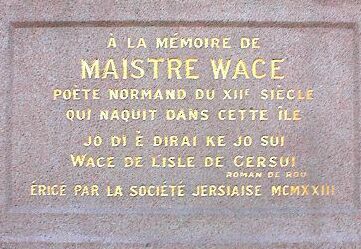 Un întèrrêssant progranme dans la saîson Nouormande sus la BBC: The Making of King Arthur. Nou pâle d'l'împortance dé Wace et dé s'n ajouôtage d'la Ronde Tabl'ye à l'histouaithe. Nou mouontre un mannuscrit du Roman dé Brut, tch'est au Collège d's Armueûthies à Londres. Mais nou n'dit pon qu'Wace 'tait d'Jèrri, ni qu'il êcrivait en Nouormand. Et nou dit qu'il avait nom Robèrt! Èrèrgardez l'progranme en lîngne.
The BBC programme on the development of the Arthur legend managed to give due weight to Wace's importance, but didn't mention that he was a Jerseyman, or that he wrote in Norman, and repeated the discredited idea that his name was Robert. Apart from those lapses in research, it's an interesting and provocative programme.
"Poet Simon Armitage traces the evolution of the Arthurian legend through the literature of the medieval age and reveals that King Arthur is not the great national hero he is usually considered to be. He's a fickle and transitory character who was appropriated the the Normans to justify their conquest..."
Wednesday, 25 August 2010
Félicitâtions! Congratulations!
Nou-s'a ouï les nouvelles qué Samantha, la femme du Preunmié Minnistre David Cameron, donnit naîssance à eune p'tite fil'ye aniet duthant lus vacanches à l'Hôpita d'Truro. Mess Cameron dit qu'i' veurt lyi donner un nom Cornouaillais.

Ch'est-i' pas damage qu'i' n'fitent pon lus vacanches en Jèrri?
It was announced on the news today that Samantha, the wife of Prime Minister David Cameron, gave birth to a baby daughter in Truro Hospital while they were on holiday. Mr. Cameron said that they want to give her a Cornish name.
Isn't it a pity they didn't choose to have their holiday in Jersey?
Photo par "Land of Hope and Glory" sus Wikimedia Commons

Monday, 23 August 2010
Les vacanches sont à finni....
Si nou veurt li pâler (partitchulièthement pouor les clâsses du sé), Colin est d'èrtou d'ses vacanches. I' s'sa à l'Office au mains les matîns chutte semaine.
For those who want to contact Colin, perhaps especially about the evening classes, he is back and will be at L'Office at least during the mornings this week.
Subscribe to:
Posts (Atom)